How *astTECS empowered MTN Ghana to deliver upto 10 Million Voice Calls Per Day with a scalable Voice Broadcasting Solution
Case Study: How *astTECS empowered MTN Ghana to deliver upto 10 Million Voice Calls Per Day with a scalable Voice Broadcasting Solution

Overview:

MTN Ghana, part of the MTN Group, the largest mobile network operator in Africa, is serving millions of subscribers across the continent. To efficiently engage its vast customer base, MTN Ghana needed a scalable, resilient, and centrally managed voice broadcasting solution that could handle huge outbound volumes for notifications, promotions, alerts, and surveys.

When legacy systems could no longer keep pace with rising demand, MTN Ghana collaborated with *astTECS to design a next-generation, telecom-grade solution that could support exponential growth while maintaining performance and reliability.

The Challenges:

Operating at a continental scale, MTN Ghana faced several operational and infrastructure challenges:

  • Managing massive outbound call volumes without performance degradation
  • Maintaining centralized campaign control with distributed execution
  • Ensuring fault tolerance to avoid service interruptions
  • Supporting IVR-based campaigns with DTMF input capture
  • Delivering real-time analytics and reporting
  • Scaling effortlessly as demand continued to rise

The legacy systems were causing performance bottlenecks and single points of failure, therefore, MTN Ghana was not able to reach the level of scale and efficiency that they required.

Solution Delivered :

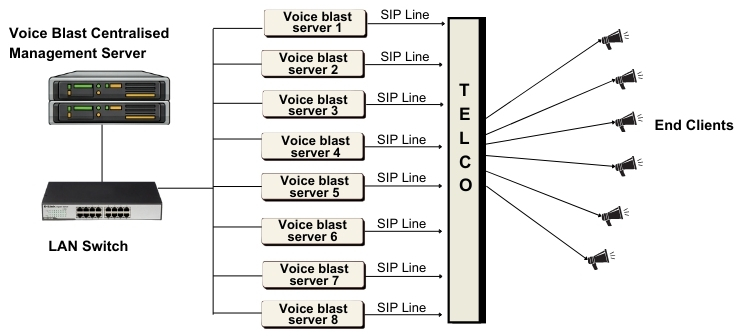
To address these challenges, *astTECS deployed a hybrid centralized–distributed architecture that transformed MTN Ghana’s large-scale voice broadcasting operations. The solution features a centralized broadcasting server that manages campaign creation, scheduling, analytics, and system administration, complemented by eight distributed execution servers that run outbound calls in parallel. This horizontally scalable architecture enables seamless capacity expansion—allowing MTN Ghana to increase call volumes effortlessly by adding additional servers as demand grows

  • Centralized Voice Broadcasting Server (Core Control Node) :

The single control node is a centralized unit in a way that it is the brain of the whole system that it manages campaign scheduling, analytics, and administration. It communicates with the execution servers located in different places very smoothly and thus gives the management both insight and control.

Features:

    • Creating and managing campaigns in a centralized way
    • Uploading of leads and scheduling
    • Role-based account controls
    • Advanced reporting and analytics
    • A unified storage space for announcements and IVRs
  • Distributed Voice Broadcasting Servers (Execution Nodes) :

The eight decentralized Voice Broadcasting (VB) servers were set up to make the outbound calls in parallel for the execution part. This horizontal scaling approach allows for a direct increase in capacity just by adding more servers. Individually, each VB Server can carry out:

    • Executing outbound calls independently
    • Playing of announcements or IVR prompts
    • DTMF input capture for feedback and surveys
    • Synchronization of real-time call results with the central node

Connectivity:

Advantages:

  • High availability through fault isolation: If one VB server fails, others continue operations seamlessly—ensuring no interruption in service delivery.
  • Load distribution intelligence: Centralized logic dynamically allocates campaigns based on real-time parameters such as server load, geographic data, and priority levels.
  • Unified configuration management: Campaign settings, IVR flows, and retry logic are configured centrally and deployed uniformly, ensuring precision and consistency.
  • Real-Time Visibility: Administrators can track ongoing campaigns, performance metrics, call completions, and IVR interaction data via intuitive dashboards.

Other benefits

The architecture is designed to deliver high throughput, making it ideal for handling large-scale calling campaigns with consistent performance. Intelligent load balancing dynamically distributes traffic across multiple servers, ensuring optimal resource utilization and uninterrupted operations. With centralized configuration, the system eliminates duplication and reduces the risk of manual errors, simplifying overall management. The flexible campaign logic supports both simple voice broadcasts and complex IVR-based call flows, allowing businesses to adapt campaigns to diverse use cases. The scalability model further strengthens the architecture, as each new Voice Blast (VB) server adds 200 channels of capacity, enabling linear performance growth and ensuring the solution remains future-proof as demand increases.

Business Outcome

  • Capacity to handle up to 10 million calls daily.
  • Campaigns executed across millions of users within hours
  • 99.9%+ uptime with fault-tolerant design
  • Supports both static announcements and IVR interaction campaigns
  • Modular scaling eliminates over-provisioning

Conclusion:

The *astTECS Voice Blast platform has transformed MTN Ghana’s communication strategy by seamlessly combining centralized intelligence with distributed execution—delivering the perfect balance of performance, reliability, and flexibility. This robust architecture enables MTN Ghana to reach millions of customers daily with urgent, time-sensitive, and mission-critical communications, while ensuring the infrastructure scales effortlessly in line with its rapidly growing subscriber base.