How astTECS Omnichannel Solution with Inbuilt Telephony Unified Lead Management, Patient Engagement, and Calling Across Three Hospital Locations
Introduction
Managing patient enquiries across multiple hospital locations can be challenging when calls, digital leads, and follow-ups are handled through separate systems. Without a centralized platform, healthcare teams may struggle to track enquiries, coordinate communication, and ensure timely follow-ups.
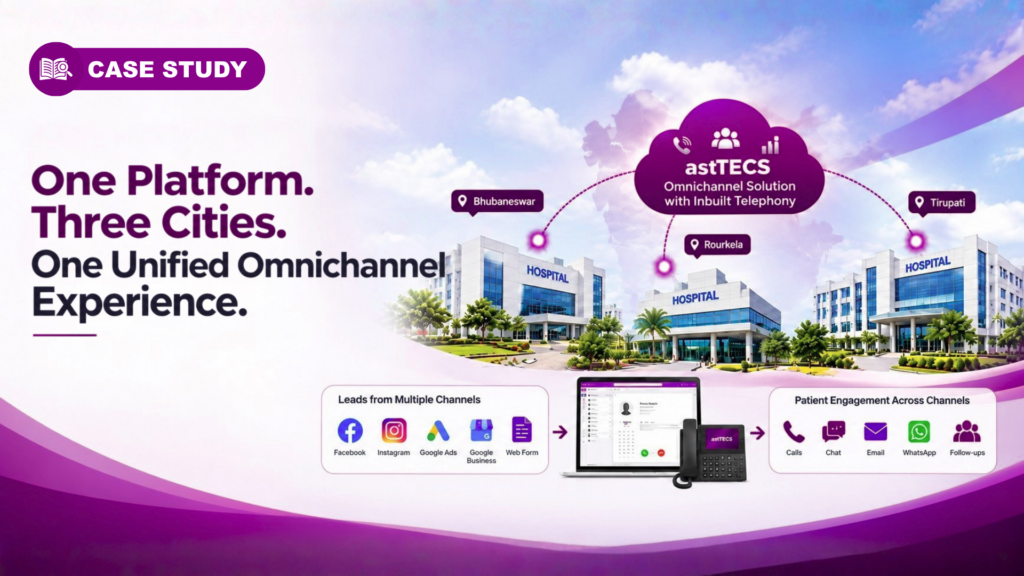
A reputed medical college and hospital serving multiple locations faced these challenges across Bhubaneswar, Rourkela, and Tirupati. To streamline communication and improve lead management, the organization implemented the *astTECS Omnichannel Solution with Inbuilt Telephony, bringing digital enquiries, customer records, calling, ticket management, and performance monitoring into one unified platform.
Client Overview
The client is a reputed medical college and hospital in Odisha operating across three locations: Bhubaneswar, Rourkela, and Tirupati. The organization receives enquiries from multiple digital channels, including Facebook, Instagram, Google Ads, Google Business, and website forms, alongside direct phone calls.
With separate SIP lines at each location, the hospital needed a centralized communication system that could connect incoming enquiries with the right teams, simplify calling, and improve visibility into follow-up activities.
Challenges: Managing Hospital Enquiries Across Three Locations
As patient enquiries arrived through multiple channels, maintaining a consistent lead management process across locations became increasingly difficult.
The key challenges included:
- Fragmented Lead Management: Enquiries from different digital platforms were difficult to track centrally.
- Delayed Follow-Ups: Without a unified view of leads and pending tasks, follow-up activities could be overlooked.
- Disconnected Workflows: Agents had to switch between applications to access customer information and make calls.
- Limited Management Visibility: Monitoring leads, calls, and follow-up activities across all three locations was challenging.
- Separate Telephony Systems: Each location had its own SIP line, requiring seamless integration with a common dialer.
- Lack of Centralized Monitoring: Managers needed a shared view of new leads, pending tasks, and delayed activities.
The hospital required an integrated solution that could connect all three locations, centralize lead management, and allow agents to communicate directly from a single interface without disrupting existing workflows.
The Solution: *astTECS Omnichannel Solution with Inbuilt Telephony
To address these challenges, *astTECS proposed and implemented an Omnichannel Solution with Inbuilt Telephony that brings lead capture, contact management, calling, ticket management, and performance monitoring together on one platform.
The solution connects enquiries from digital channels to a centralized contact management system, allowing agents to access customer details and initiate calls from the same interface.
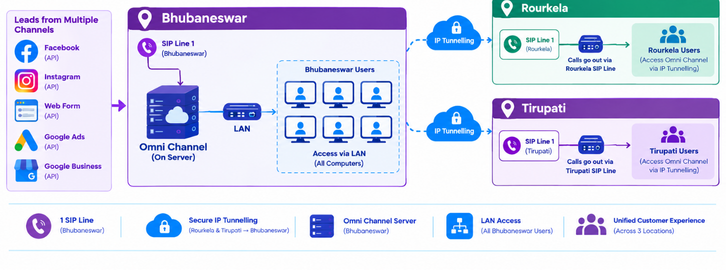
It also integrates the SIP lines of Bhubaneswar, Rourkela, and Tirupati into a unified dialer environment, helping the hospital coordinate communication across its locations.
Multi-Location SIP Integration
*astTECS proposed two approaches for connecting the existing SIP lines to the centralized telephony platform:
- Secure IPsec Tunnelling
Establishes secure private connectivity between locations to enable SIP communication with the centralized platform.
- SIP Gateway Integration
Uses SIP gateways to connect each location’s existing SIP line to the unified telephony platform.
The appropriate approach can be selected based on the customer’s network infrastructure and deployment requirements.
Ready to streamline your healthcare communication?
Contact USHow the Omnichannel Solution Works
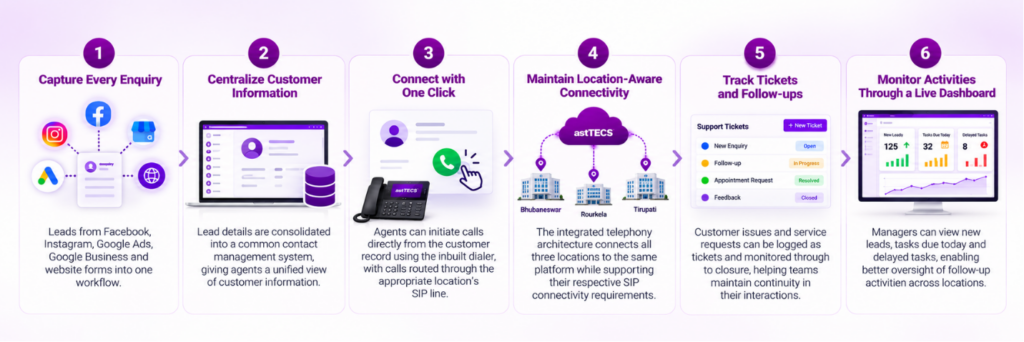
The *astTECS solution simplifies the hospital’s lead management and communication workflow through the following process:
1. Capture Enquiries from Multiple Channels
Enquiries from Facebook, Instagram, Google Ads, Google Business, and website forms are brought into a common lead management workflow.
2. Centralize Customer Information
Lead details are consolidated into a centralized contact management system, giving agents a unified view of customer information.
3. Enable One-Click Calling
Agents can initiate calls directly from customer records using the inbuilt dialer. Calls are routed through the appropriate location’s SIP line.
4. Connect All Three Locations
The integrated telephony architecture brings the three locations onto one platform while supporting their respective SIP connectivity requirements.
5. Manage Tickets and Follow-Ups
Customer issues and service requests can be recorded as tickets and tracked through to closure, helping teams maintain continuity in customer interactions.
6. Monitor Activities Through a Live Dashboard
Managers can view new leads, tasks due today, and delayed activities through a live dashboard, improving visibility into follow-up priorities across locations.
Key Features Delivered to the Medical College and Hospital
The deployment included the following capabilities:
- Multi-Location SIP Connectivity: SIP lines from Bhubaneswar, Rourkela and Tirupati on one platform, via IPsec tunnel or SIP gateway.
- Omni Channel Software: Contact and ticket modules with user performance reports, for upto 50 users.
- Omni-Channel Lead Capture: Enquiries from Facebook, Instagram, Google Ads, Google Business and website forms are brought into a common lead management workflow.
- Inbuilt Dialer with 50 Concurrent Calls: The integrated dialer supports up to 50 concurrent calls, with IVR configuration, call reports and voice recordings.
- Single-Screen Dial: Agents can access customer information and initiate calls from the same interface, reducing unnecessary screen switching and simplifying their daily workflow.
- Geo-Tagging: GPS-based address information can be associated with customer profiles, supporting location-aware record management where required and permitted.
- Live Dashboard: Dashboards highlight new leads, pending tasks and delayed activities, giving managers a clearer view of team workloads and follow-up priorities.
- Faster Deployment and Enablement: The implementation plan included installation and online training within 21 days, along with six months of support.
The implementation plan also included installation and online training within 21 days, along with six months of support.
Connectivity
Outcomes: A More Connected Customer Engagement Workflow
With the *astTECS Omnichannel Solution and Inbuilt Telephony, the hospital established a common operating environment for lead management and calling across its three locations.
The key outcomes included:
1. Centralized Lead Management
Enquiries from Facebook, Instagram, Google Ads, Google Business, and website forms were brought into a common workflow, making lead tracking and follow-ups more organized.
2. Simplified Agent Workflows
Agents could access customer information and initiate calls from a single interface, reducing unnecessary application switching.
3. Unified Communication Across Three Locations
The SIP lines from Bhubaneswar, Rourkela, and Tirupati were integrated into one telephony platform, supporting more coordinated calling operations.
4. Improved Management Visibility
A shared dashboard provided visibility into new leads, tasks due, and delayed activities, helping managers monitor follow-up priorities.
5. Consistent Telephony Operations
The integrated platform supported IVR configuration, call reporting, and voice recordings within the centralized telephony environment.
6. Scalable Communication Infrastructure
The unified architecture provides a foundation for considering additional locations, lines, and users as business requirements evolve, subject to infrastructure and licensing requirements.
These outcomes describe the capabilities and operational improvements documented for the deployment; specific percentage improvements in response time, lead conversion, or patient satisfaction were not provided.
Unify Your Hospital Communication with *astTECS
Talk to our ExpertsBefore vs. After: Hospital Communication and Lead Management
Area | Before Implementation | With *astTECS |
Lead Management | Enquiries spread across multiple channels | Centralized lead management workflow |
Customer Information | Agents switched between applications to get Customer data | Customer records accessible through one Unified dashboard |
Calling | Separate SIP lines across locations | Integrated telephony platform |
Follow-Up Tracking | Limited visibility into pending activities | Dashboard for new leads, due tasks, and delayed tasks |
Ticket Management | No proper ticket management system | Centralized ticket management system |
Call Monitoring | No proper call monitoring system | IVR, call reports, and voice recordings on one platform |
Multi-Location Operations | Separate communication setups | Three locations connected through a unified solution |
Why Omnichannel Communication Matters for Healthcare Organizations
Healthcare organizations need more than a telephone system. They need an effective way to manage enquiries, coordinate communication, and ensure that follow-ups receive attention.
When different branches rely on separate phone lines and disconnected lead lists, teams may find it difficult to maintain visibility and consistency.
An omnichannel solution for healthcare helps address these challenges by connecting digital enquiries, customer records, telephony, and follow-up management within a common workflow.
With the right healthcare communication platform, organizations can:
- Bring enquiries from multiple digital channels into one system.
- Help agents initiate calls directly from customer records.
- Improve visibility into pending leads and follow-up activities.
- Coordinate telephony across multiple hospital locations.
- Organize customer interactions and service requests.
- Build a scalable communication infrastructure for future requirements.
Conclusion: Unifying Healthcare Communication with *astTECS
Managing enquiries across multiple hospital locations requires coordinated lead management, reliable telephony, and clear visibility into follow-up activities. Disconnected systems can make these processes more difficult to manage as operations grow.
By implementing the *astTECS Omnichannel Solution with Inbuilt Telephony, the medical college and hospital brought three locations onto one platform, centralized enquiries from five digital sources, and enabled agents to manage customer information, calls, tickets, and follow-ups through a unified interface.
This case study demonstrates how omnichannel software with integrated telephony can help healthcare organizations streamline communication, improve operational visibility, and establish a scalable foundation for customer engagement.
If your hospital or healthcare organization is looking to unify lead management, simplify calling, and coordinate communication across multiple locations, *astTECS can help you explore a solution suited to your requirements.
