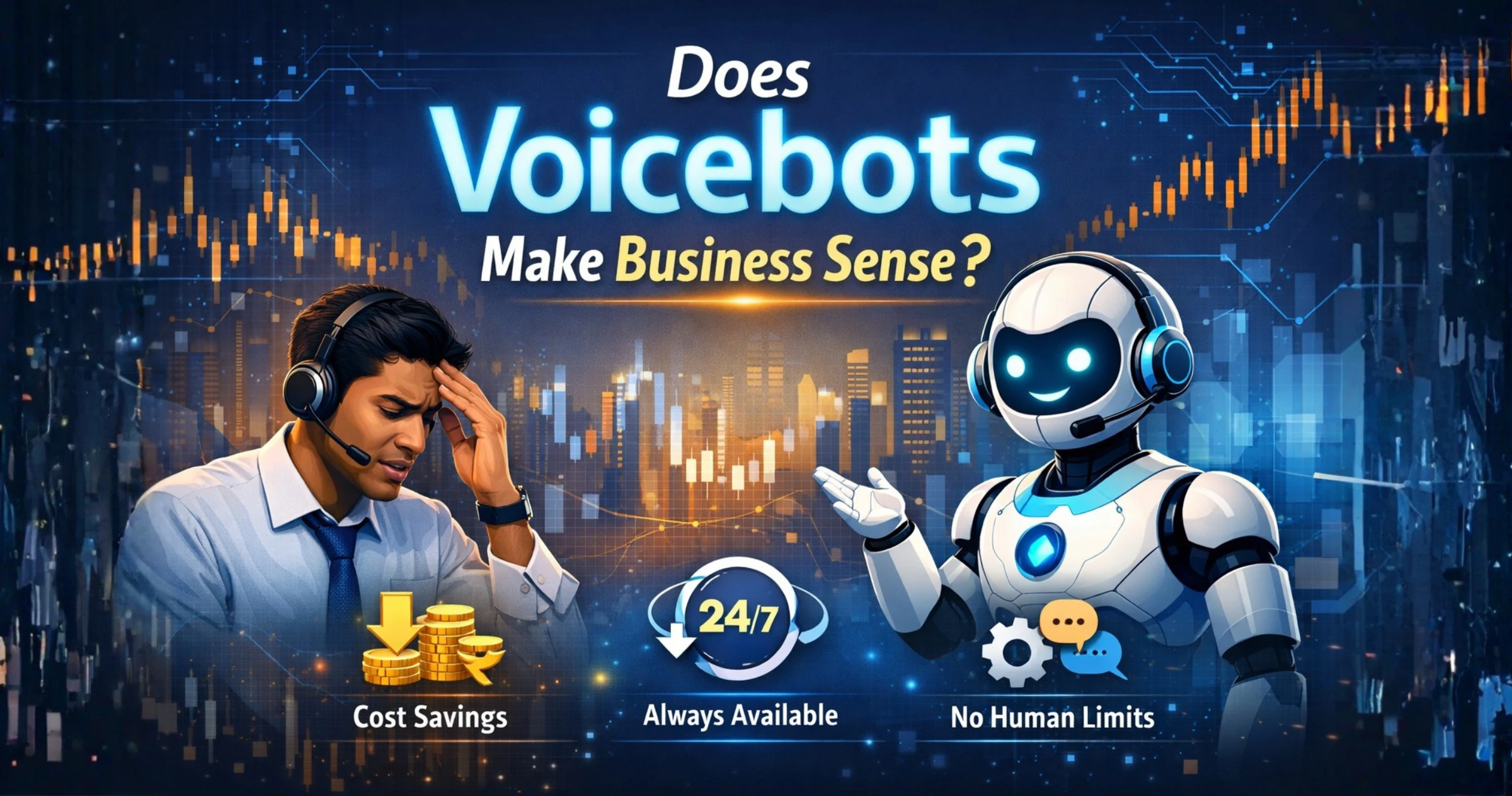
 Does Voicebots Make Business Sense?
The rapid advancement of conversational AI has brought voicebots to the forefront of enterprise automation strategies. Organizations across industries—especially in telecom, BFSI, e-commerce, and healthcare—are increasingly evaluating whether voicebots can replace human agents in customer interaction workflows.
While the promise is compelling, the real question remains: do voicebots make economic sense today?
The Core Value Proposition of Voicebots
Voicebots are primarily positioned as a replacement for human agents in repetitive communication tasks such as:
- Customer support calls
- Appointment reminders
- Payment follow-ups
- Lead qualification
Beyond replacement, voicebots offer several inherent advantages:
- 24×7 availability without shift constraints
- Consistency in tone and response (no mood swings or fatigue)
- Zero impulse behavior (no human error due to stress or emotion)
- Scalability on demand (handle spikes without hiring delays)
However, despite these benefits, cost efficiency remains the single most critical factor driving adoption decisions.
Cost Comparison: Human Agent vs. AI Voicebot
| Key Metrics | Human Agent (Current) | AI Voicebot (Target) |
|---|---|---|
| Cost Per Minute | ~ ₹3.80 – ~ ₹4.00 | ~ ₹1.00 – ~ ₹2.00 |
| Monthly Total (6,500 mins) | ~ ₹25,000 | ~ ₹6,500 – ₹13,000 |
| Availability | 8 Hours (Shift-based) | 24/7/365 (Instant) |
| Scalability | Limited by Hiring/Training | Unlimited / On-Demand |
| Economic Decision | High Overhead | 75% Potential Savings |
When Does Replacement Make Sense?
For any automation technology to replace human labor at scale, it must deliver a significant economic advantage.
Industry benchmarks suggest that:
A 50% cost reduction is the minimum threshold for serious consideration
A 75% reduction makes adoption highly compelling
Therefore:
Target cost for voicebots should ideally be: ~ ₹1 – ₹2 per minute
This becomes the “sweet spot” where enterprises can confidently replace human agents while maintaining margins and ROI.
Key Indian Players
Among domestic providers, notable companies include:
 [Sarvam AI]
 [Gnani.ai]
[CoRover.ai]

These companies are currently offering solutions in the range of ~ ₹2 – ₹5 per minute (and above, depending on complexity and scale)
The Reality Check
At current pricing levels:
Voicebots are approaching parity with human agents
In some optimized deployments, they can deliver moderate cost savings
However, widespread replacement purely based on cost is still marginal
This means that today, voicebots are best suited for:
High-volume, repetitive interactions
Outbound campaigns (collections, reminders, surveys)
First-level support automation
Rather than a complete replacement, they often act as a force multiplier for human teams.
The Road Ahead
The trajectory of voice AI suggests a strong shift in the near future:
Rapid improvements in speech quality and naturalness
Better contextual understanding via advanced LLMs
Falling infrastructure and model costs
As competition intensifies and technology matures, we can expect:
Voicebot pricing to drop below ₹1 per minute
At that point, the economics will decisively favor automation, enabling:
Near-complete replacement of human agents for repetitive tasks
Massive cost savings for enterprises
Standardization of customer interaction quality
